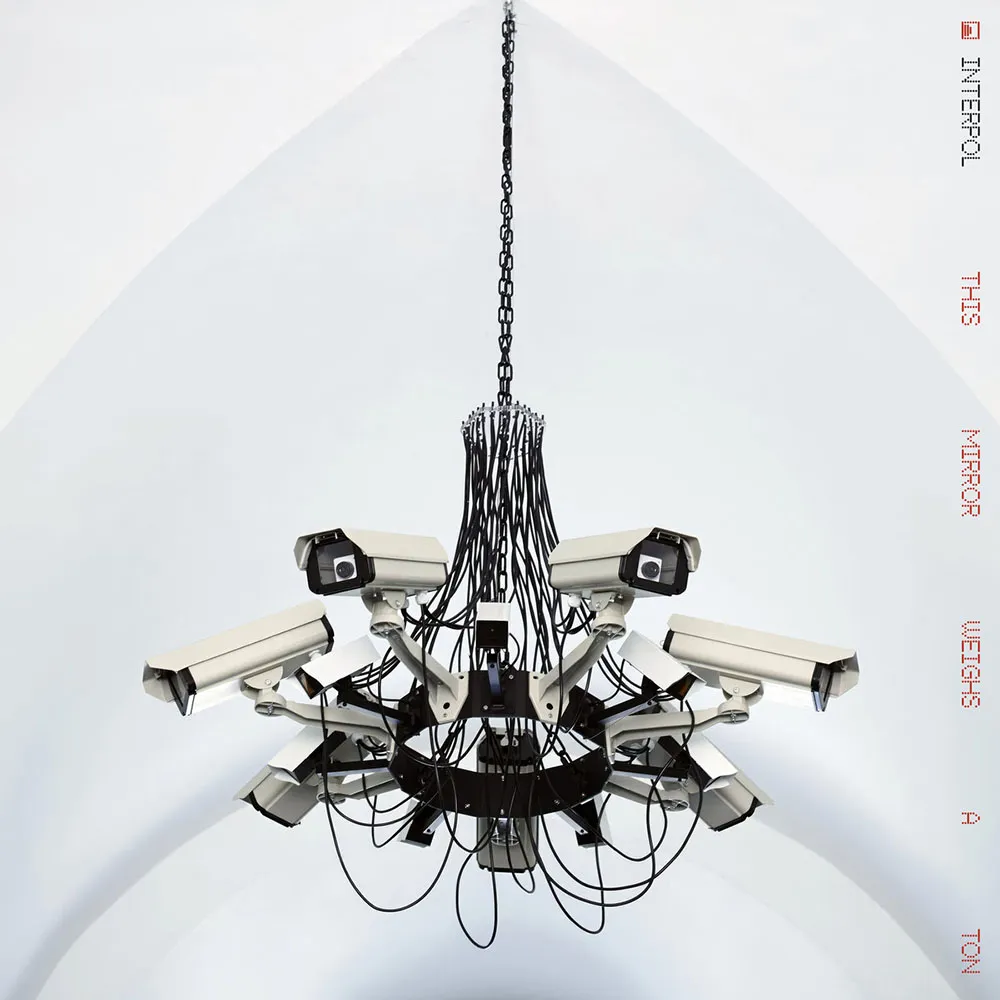
Wings On Fire arrives midway through Interpol's This Mirror Weighs a Ton, and it immediately feels like the album's emotional pressure point. Released in August 2026 on Partisan Records, the band's eighth studio set turns reflection and distortion into a governing aesthetic, and this track is where that inward gaze becomes most volatile. Paul Banks's vocals carry the same controlled distance that defined Turn On the Bright Lights, yet the lyrics suggest a narrator who has traded action for prophecy, converting helplessness into the claim that everything was foreseen.
The production, handled by Andrew Wyatt at ARCOS Sound in New York, gives the song a widescreen clarity without sacrificing Interpol's characteristic shadow. Guitars from Daniel Kessler and Paul Banks interlock in the band's familiar post-punk lattice, while Sam Fogarino's drums keep time with a precision that feels more psychological than physical. Brandon Curtis's keyboards and synthesizers widen the palette established on The Other Side of Make-Believe, but nothing is pasted on for novelty; the electronics deepen the unease already present in the chord movement and vocal delivery.
What distinguishes Wings On Fire within the record is how directly it addresses surveillance and self-concealment. Lines about withholding purpose and refusing legibility sit beside imagery of torched thrones and blood from stones, and the tension between proclamation and paranoia gives the song its charge. Interpol have always excelled at making alienation sound architectural, and here that architecture feels newly urgent: a post-punk framework built to house a world in which visibility itself has become a risk.
By the time the outro softens into something closer to longing, the track has completed a subtle arc from diagnosis to admission. The wings of the title are not triumph but damage, and the fire is less destruction than exposure. Within This Mirror Weighs a Ton, the piece confirms the album's premise that familiar shapes can be refracted into something slightly alien; Interpol sound like themselves, yet the mirror they hold up weighs more than it did a decade ago.
For a band whose identity rests on restraint, Wings On Fire proves that restraint can still generate heat. Interpol do not reinvent their language on this album, but they extend it with a song that treats prophecy as the last power available when every other lever has slipped away. Four minutes and fifteen seconds is enough for the band to make that condition feel both personal and vast, and enough for the listener to understand why the mirror on their latest record feels so heavy.