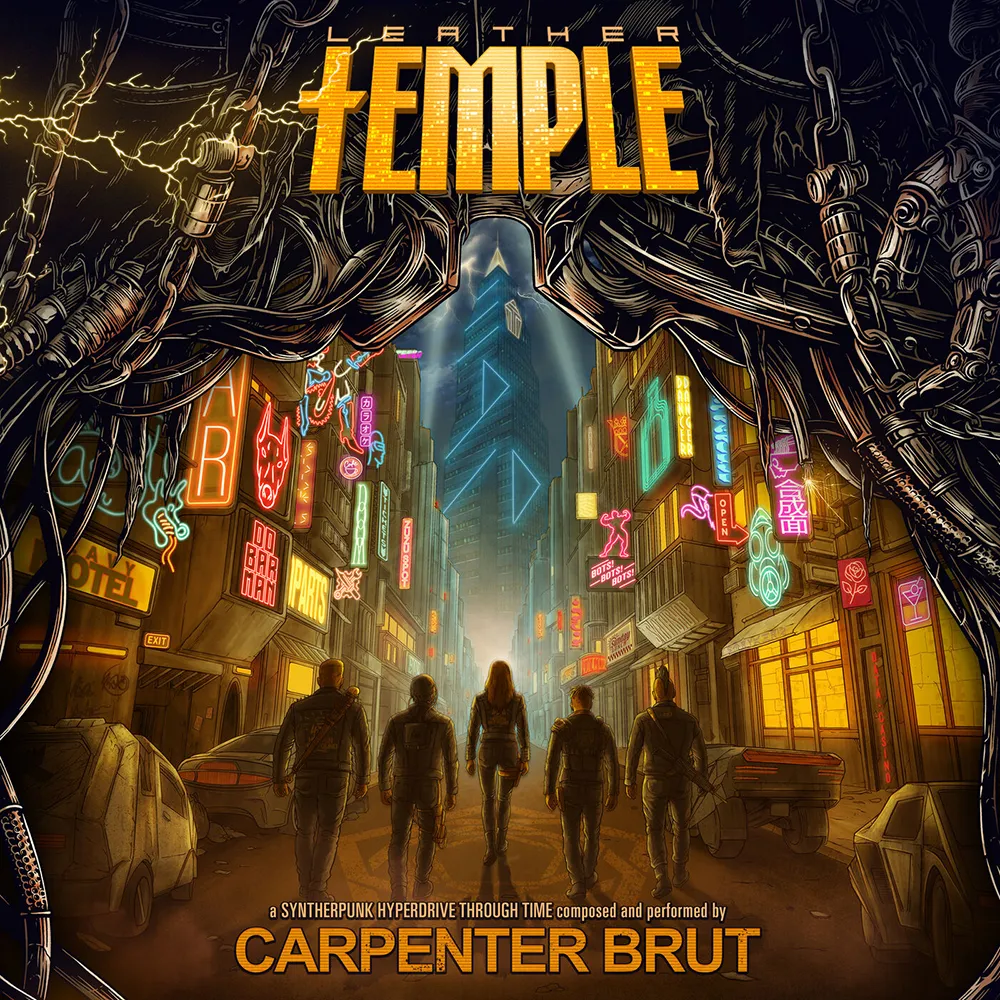
Leather Temple arrives as the third and final chapter in Carpenter Brut's Leather saga, and it wastes no time reminding the listener why Franck Hueso's alias became synonymous with cinematic synthwave turned feral. Released in early 2026 through No Quarter Prod, the album completes a narrative arc that began with Leather Teeth and Leather Terror, but where those records still flirted with guest vocalists and rock spectacle, Leather Temple is almost entirely instrumental, a decision that pushes the focus back onto melody, rhythm, and the pulp mythology of Midwichopolis in 2077.
What distinguishes the record within Carpenter Brut's catalogue is how deliberately it trades nostalgia for pressure. Tracks such as Major Threat, Neon Requiem, and Speed or Perish stack distorted bass, stabbing arpeggios, and industrial percussion until the sound feels less like a dance floor than a chase sequence. Yet Hueso never abandons the hook-driven logic that made Trilogy a gateway drug for an entire generation of darksynth producers; the melodies are still there, often glowing at the centre of the mix like emergency signage in a corridor that is flooding with smoke.
The title piece sits near the front of the sequence and functions as a mission statement: leather, machinery, and neon treated as religious materials in a temple built from samples and saturation. Iron Sanctuary and The Misfits / The Rebels widen the palette toward horror-score menace and hard-driving metal crossover, while The End Complete offers a six-minute comedown that feels like dawn after a night of synthetic violence. Mixed and mastered by Thibault Chaumont, the production keeps every layer legible even at maximum density, which is essential when the emotional register swings between exhilaration and dread within the same bar.
For followers of the live spectacle, Leather Temple also reads as a blueprint for the End Complete tour that followed release, an album designed to translate directly into strobes, leather, and crowd catharsis. Carpenter Brut has always understood that his music is as visual as it is sonic; here that understanding reaches its most refined form, an instrumental opera for fans of Blade Runner, Italian giallo, and Judas Priest alike, without needing a single scream to sell the stakes.
By its close, Leather Temple has done what a trilogy capstone should: it has made the preceding records feel inevitable while still raising the temperature. Carpenter Brut leaves the listener inside a world where retro futurism is not comfort but confrontation, and where the only resolution is to keep moving faster than the darkness behind you. In 2026, that fever dream still feels startlingly alive.