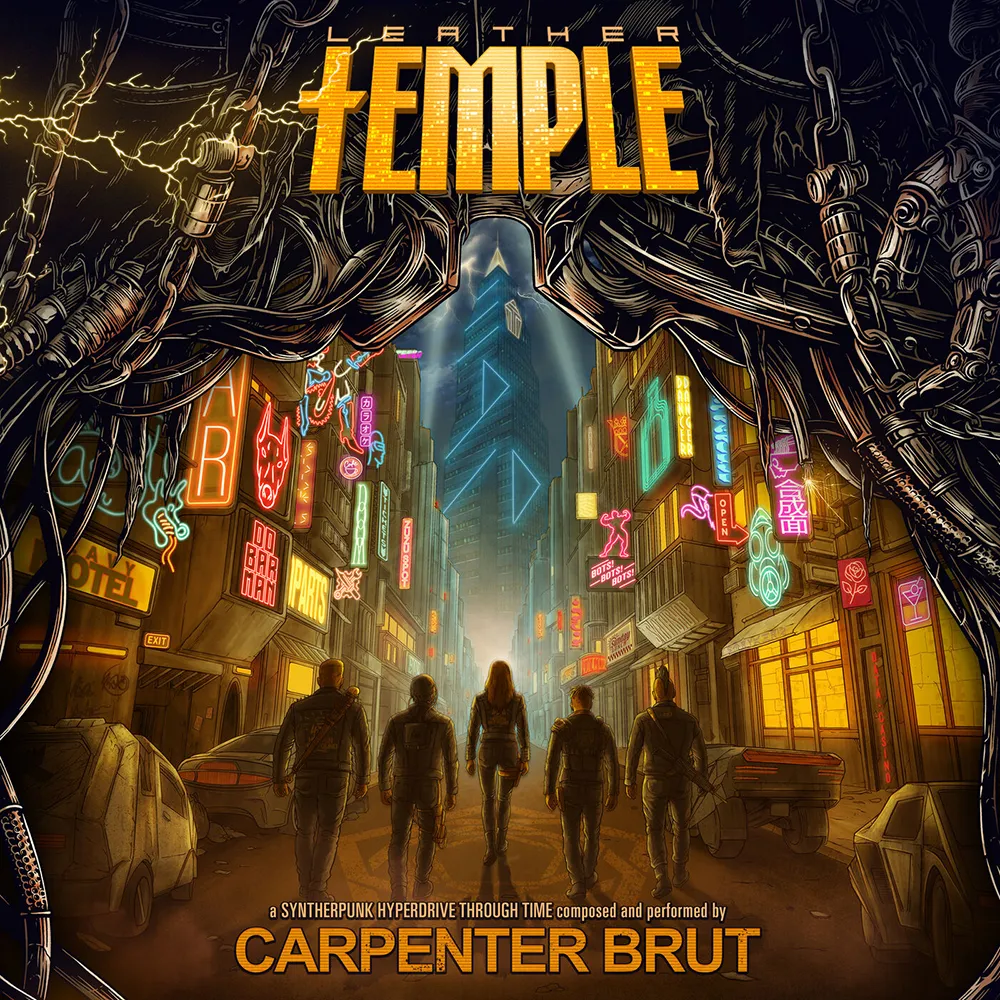
With Leather Temple, Carpenter Brut pushes his distinctive fusion of dark synthwave, industrial electronics, and heavy metal into increasingly aggressive and cinematic territory. Continuing the dystopian universe established across his previous releases, the French producer Franck Hueso transforms his fascination with horror cinema, retro-futuristic aesthetics, and exaggerated violence into a soundtrack of mechanical excess. Where Trilogy captured the neon-lit excitement of imaginary 1980s thrillers and Leather Terror embraced a more explicitly metallic intensity, Leather Temple feels like the culmination of an increasingly uncompromising vision, a descent into a world where machines, flesh, and electricity have become almost indistinguishable.
From its opening moments, the album establishes an atmosphere of relentless tension. Distorted synthesizers surge through dense layers of electronic percussion, while thunderous bass frequencies and razor-sharp rhythmic sequences create an almost physical sense of pressure. Carpenter Brut’s characteristic melodic hooks remain present, but they are frequently buried beneath abrasive textures and monumental arrangements. The music evokes deserted industrial landscapes, flickering fluorescent corridors, and futuristic cities illuminated by the cold glow of artificial light. Every transition feels designed for maximum cinematic impact.
The record’s pacing is driven by contrast between explosive rhythmic passages and moments of ominous suspension. Carpenter Brut constructs his compositions around insistent electronic patterns, gradually introducing new layers until the arrangements reach a point of near-saturation. Yet beneath the apparent brutality lies a precise understanding of tension and release. Melodies emerge from walls of distortion, synthesizer arpeggios cut through the rhythmic machinery, and sudden shifts in dynamics give the music the unpredictable momentum of an action sequence unfolding in real time.
What distinguishes Leather Temple from more conventional synthwave is its refusal to treat the aesthetics of the 1980s as an exercise in nostalgia. Carpenter Brut draws upon the visual language of VHS horror, cyberpunk cinema, and exploitation films, but transforms these references into something considerably darker and more confrontational. The influence of industrial music and extreme metal is especially pronounced, giving the album a harsh physicality that moves beyond the polished retro-futurism commonly associated with the genre. Rather than recreating an imagined past, Hueso constructs an alternative future shaped by its most disturbing fantasies.
Sonically, the album is built around density, distortion, and carefully controlled excess. The low frequencies carry enormous weight, while aggressive synthesizer leads occupy the upper register with an almost metallic sharpness. Percussion is compressed and forceful, often blurring the distinction between electronic drum programming and the impact of live rock instrumentation. Despite the intensity of the arrangements, the production maintains a strong sense of spatial organization, allowing individual melodic elements to emerge from the surrounding chaos. It is music designed to overwhelm without completely sacrificing clarity.
While Leather Temple remains rooted in electronic music, its emotional vocabulary is closer to that of horror cinema and industrial metal than traditional dance music. Carpenter Brut’s compositions thrive on confrontation, creating an atmosphere where exhilaration and menace become inseparable. Yet there is also a theatrical dimension to the violence, an awareness of spectacle that prevents the record from becoming merely oppressive. The exaggerated gestures, dramatic transitions, and relentless rhythmic propulsion suggest an artist fully committed to the imaginative possibilities of his own dark universe.
By the time Leather Temple reaches its conclusion, the listener is left with the sensation of having travelled through a vast, hostile, and strangely seductive mechanical landscape. Carpenter Brut offers little in the way of comfort or resolution, instead embracing the visceral power of repetition, distortion, and cinematic grandeur. The album stands as an uncompromising expression of his aesthetic, a collision of electronic precision and metallic aggression in which the machinery never stops moving and the darkness seems to generate its own blinding light.