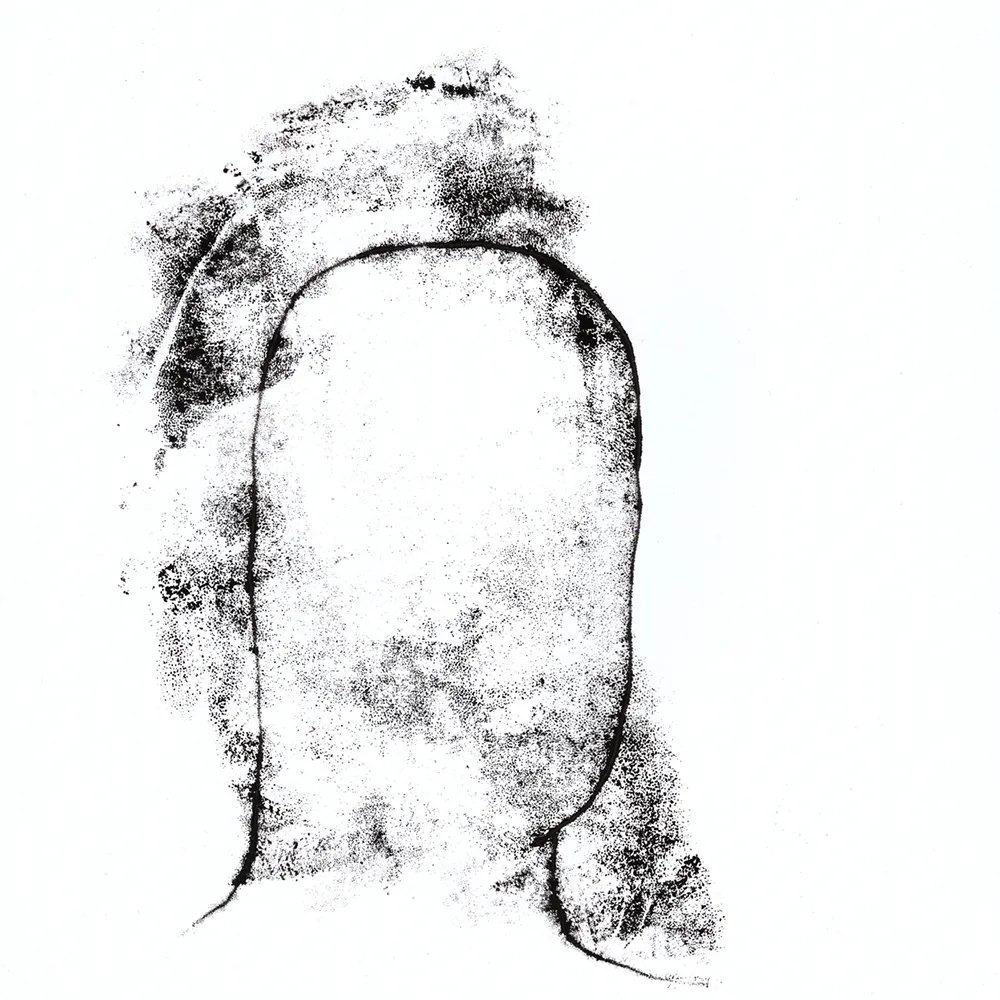
Slate-Coloured Storm does not begin so much as condense. Abul Mogard's 2015 album Circular Forms opens with this piece, and from its first sustained tones the record establishes a world governed by slow rotation rather than narrative progression. The Italian musician, working here under the alias that would define his solo career, treats the Farfisa organ and modular synthesis as instruments of mass and patience, building a sound that feels geological: layered, patient, and heavy in a way that has nothing to do with volume alone.
What distinguishes the track within Mogard's catalogue is how completely it announces his method. There is no hurry toward melody or release; instead, harmonic drift and filtered timbre accumulate until the listener is inside the weather itself. Slate-Coloured Storm lives up to its title in both colour and temperament, a grey-fronted passage whose emotional register sits between mourning and awe. The production, mastered by Denis Blackham for Ecstatic, preserves every overtone without softening the piece's austere intent, and the result still sounds immediate a decade on.
Within Circular Forms, this opening movement sets the terms for everything that follows. The album's four tracks share a circular logic, returning to similar densities and durations rather than chasing conventional arcs, and Slate-Coloured Storm is the threshold: the moment where Mogard invites the listener to abandon expectation of climax and submit to duration. Compared with the longer closing piece House on the River, it is compact, yet it carries the same conviction that ambient music can be as physically demanding as any louder form when it refuses to let go.
For those who encountered Abul Mogard only through later collaborations or live modular work, this track remains the purest distillation of his early identity. It is astral without being decorative, mournful without performing sadness, and entirely committed to the idea that a single sustained field of sound can hold more tension than any conventional song structure. Circular Forms would broaden that language across its remaining sides, but nothing on the record quite matches the clarity of purpose with which Slate-Coloured Storm first turns the room to stone and then slowly lets the light change.
By its close, the piece has done the work of an overture without ever announcing itself as one. Abul Mogard leaves the listener suspended inside a storm that never breaks into drama, only deepens, and that restraint is precisely why the track endures. In a landscape crowded with ambient releases that mistake repetition for depth, Slate-Coloured Storm still stands apart: proof that patience, when held with this much conviction, can feel as monumental as any crescendo.