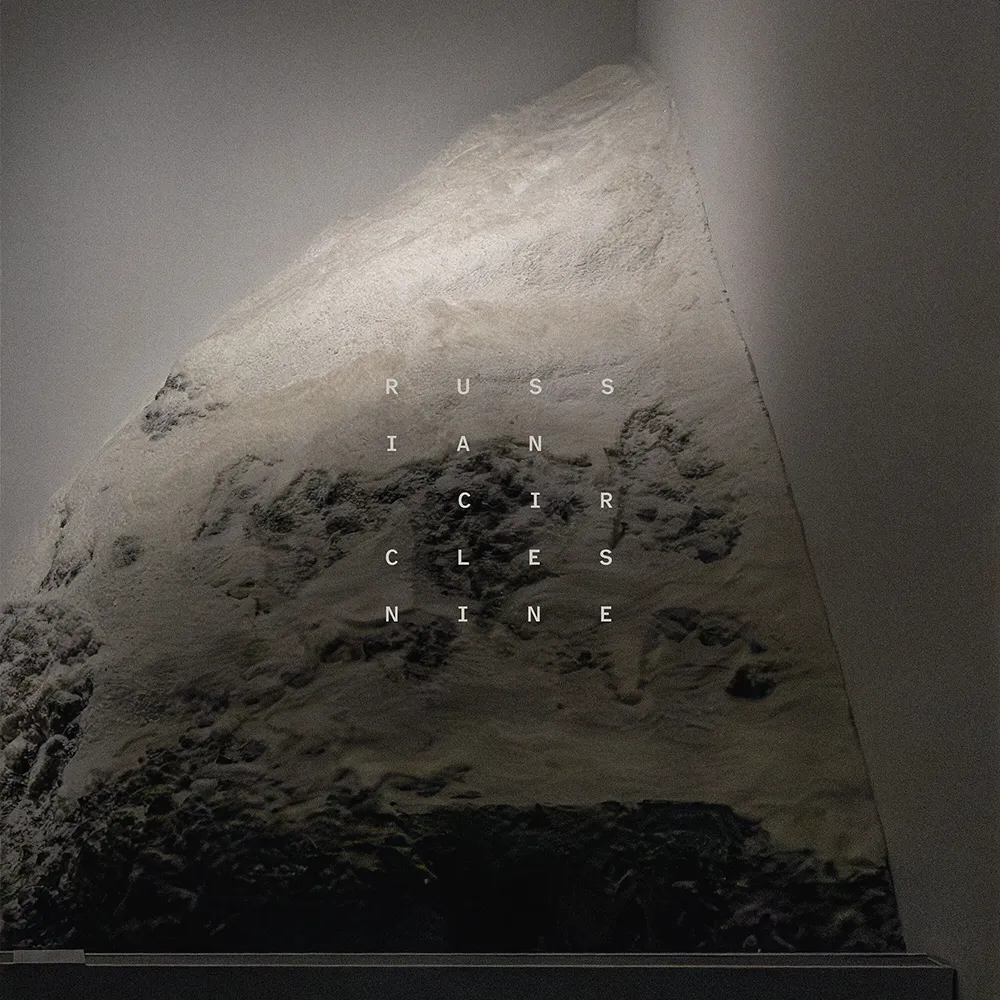
Released in 2026 on Sargent House, Russian Circles’ Nine is a monumental work of instrumental post-metal that finds the Chicago trio refining their familiar language of tension, repetition, and overwhelming release. Where earlier records often moved restlessly between atmosphere and aggression, Nine feels more deliberate, a meditation on endurance, distance, and the passage of time, expressed through music that can be both brutally physical and strangely beautiful.
From the opening moments of Borehole, the band creates a sense of movement toward something vast and unknowable. Mike Sullivan’s guitar lines rise through layers of distortion while Brian Cook’s bass supplies a subterranean pull and Dave Turncrantz’s drums drive the composition forward with imposing precision. The track circles around recurring motifs, briefly suggesting escape before descending once more into darkness, like a journey whose destination is buried too deep to reach.
The record’s heaviest moments are remarkably controlled. Empath compresses thrash, black metal, d-beat, and hardcore into less than five minutes without sounding fragmented. Cook’s grinding bass tone and Turncrantz’s relentless percussion give the track the force of industrial machinery, while Sullivan’s riffs arrive in sudden, violent shifts. Yet the aggression never feels chaotic for its own sake; every impact is carefully placed, revealing a band whose power comes as much from discipline as volume.
At the center of the album, Eluvial stretches into a slow-moving catastrophe. Delayed guitar figures pass back and forth above an intricate rhythmic foundation, gathering weight almost imperceptibly until the composition breaks open. The melody does not simply repeat but erodes and reforms, as though shaped by water moving through stone. It is Russian Circles at their most patient, allowing a small musical idea to accumulate enough pressure to transform the entire landscape around it.
The second half of Nine expands that landscape further. E2 introduces pulsing synthesizers, dub-like bass, and winding finger-tapped guitar patterns, giving the music an unfamiliar sense of elasticity. Meridian, by contrast, is built around bright, Reich-like arpeggios and propulsive drumming. Its momentum evokes movement through a city after dark, streetlights passing in rhythmic intervals, glass towers appearing and disappearing against the night.
The closing sequence offers the album’s most striking contrast. Recorded at Rancho De La Luna in Joshua Tree, Arletta is a solitary nylon-string guitar piece whose warmth and fragility briefly clear the air. That stillness makes Seventh Seal feel even more devastating when it arrives. The final track abandons restraint for a direct metallic assault, ending the record not with resolution but with confrontation. Beauty and brutality are not treated as opposites here; each gives the other greater weight.
Engineered and mixed by Kurt Ballou, with sessions at Electrical Audio in Chicago and God City in Salem, Nine possesses immense physical presence without sacrificing detail. The drums remain sharp inside the densest passages, the bass feels almost architectural, and even the most distorted guitars retain their contours. The cover image of Tony Tasset’s Snowpile for Chicago mirrors this balance: an artificial monument to something cold, dirty, temporary, and strangely moving.
By the time Nine reaches its final silence, it feels less like a reinvention than the culmination of more than two decades of shared musical instinct. Russian Circles have become masters of transforming repetition into narrative and sheer weight into emotion. The album leaves behind the impression of a landscape reshaped by pressure, austere, scarred, and magnificent.