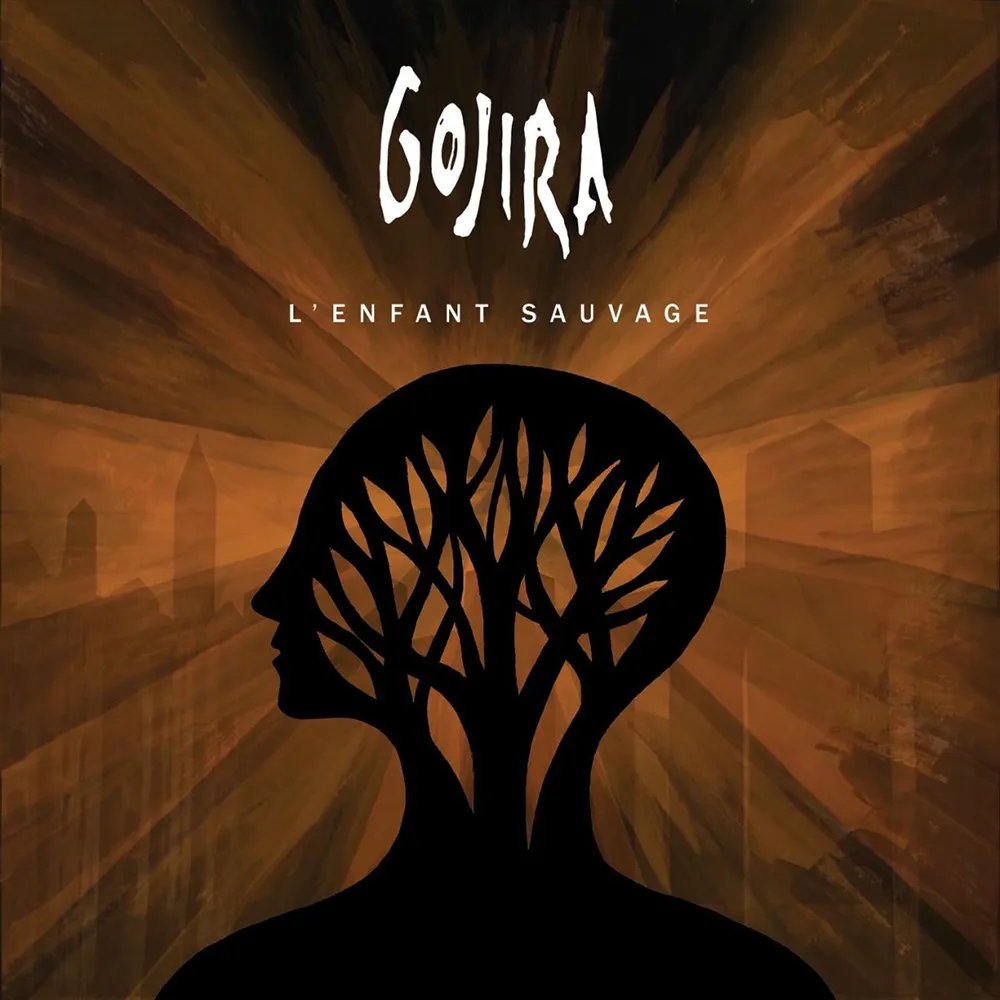
Released in 2012 on Roadrunner Records, Gojira’s L’Enfant Sauvage is a monumental work of progressive metal built around questions of freedom, instinct, and self-determination. Its title translates as The Wild Child, and the album repeatedly returns to the struggle between individual consciousness and the systems, social, technological, and psychological, that attempt to contain it.
The opening track, Explosia, begins with a violent burst of tightly controlled motion. Joe and Christian Andreu’s guitars scrape and recoil through syncopated riffs while Jean-Michel Labadie’s bass reinforces their enormous low-end weight. Mario Duplantier’s drumming remains the central force: precise enough to navigate every rhythmic turn, but physical enough to make the song feel as though the ground itself is shifting.
The title track compresses Gojira’s identity into four breathless minutes. Grinding guitar patterns give way to slower, more contemplative passages before the band surges forward again. Joe Duplantier’s voice carries fury without losing clarity, framing freedom not as comfort but as a frightening responsibility. To become the wild child is to reject imposed certainty and face existence without protection.
The Axe and Liquid Fire deepen the album’s atmosphere of spiritual confrontation. Their riffs move with mechanical force, but the imagery remains elemental: flame, earth, blood, and transformation. Gojira’s music frequently places nature against industry, yet L’Enfant Sauvage complicates that divide. The violence is not only external; it exists within the self, where destructive impulses and the desire for transcendence occupy the same space.
The brief instrumental The Wild Healer provides a moment of suspension before Planned Obsolescence restores the pressure. Its title evokes a culture designed around waste, replacement, and endless consumption. The song’s tightly repeating patterns resemble an industrial process accelerating beyond human control, while Mario’s unpredictable accents keep the machinery from settling into comfortable repetition.
On Mouth of Kala and The Gift of Guilt, the album reaches its greatest emotional depth. The former moves with the patience of something ancient, its central riff circling like a force too large to resist. The Gift of Guilt is more openly melodic, building from tapping patterns and sustained chords toward a sweeping conclusion. Guilt becomes both burden and guide, a source of suffering that also proves the conscience remains alive.
Produced by Joe Duplantier and Josh Wilbur, and recorded at Spin Studios in New York, L’Enfant Sauvage is exceptionally dense without becoming indistinct. The guitars possess a serrated texture, the bass remains audible beneath them, and the drums cut through with startling definition. Wilbur’s mix gives the record modern precision while preserving the organic force of four musicians performing at their physical limits.
The closing stretch turns increasingly inward. Pain Is a Master treats suffering as a severe form of instruction, while Born in Winter begins in meditative stillness before rising into one of the album’s most powerful crescendos. The Fall ends the record with no simple victory, only the recognition that collapse, renewal, and consciousness are part of the same continuing cycle.
By the time L’Enfant Sauvage reaches silence, its search for freedom remains deliberately unresolved. Gojira offer no escape from responsibility or pain; instead, they suggest that freedom begins with the willingness to confront both. The result is an album of immense physical power and philosophical weight, a record that sounds like the human spirit attempting to tear its way out of a machine.